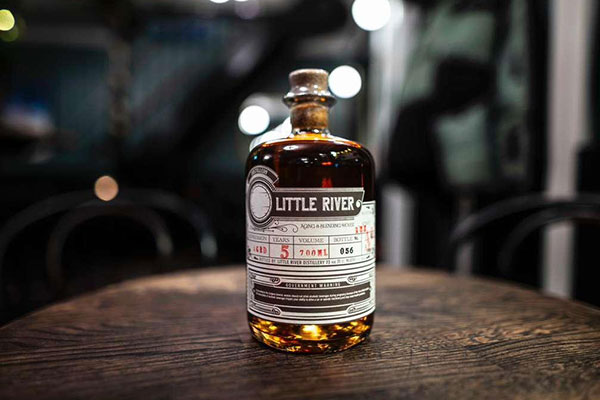
Put four glasses on a table. Same distillate, same warehouse, same hands. The only variable is time — one year, three years, five years, eight years. By the fourth glass you are drinking something the first glass could not have predicted.
This is the part of rum-making that no amount of skill can rush. You can adjust a fermentation in an afternoon and a cut on the still in minutes. The barrel works on its own schedule, and all you get to decide is when to stop asking.
What the barrel is actually doing
Three processes run at once inside a cask, and they pull in different directions.
The wood gives. Oak is not a neutral container. Heat it — char it, toast it — and the sugars in the wood caramelise while the lignin breaks down into vanillin. That is where vanilla comes from. Not an additive: the barrel. Oak also contributes the tannin that gives an aged spirit grip, the faint coconut note that comes from lactones in American oak, and the toasted, spiced edge you find at the back of an older pour.
The spirit takes away. The char layer works like a filter. Sulphury, sharp, green notes present in young distillate get adsorbed onto that carbon and stop being part of the conversation. Much of what aging does is subtraction — the removal of things you would rather not taste.
The air changes everything. A barrel breathes. Oxygen moves slowly through the staves, softening harsh compounds and building the dried-fruit, sherried character that people recognise as "old." Meanwhile liquid evaporates out — the angel's share — and what stays behind gets more concentrated.
Why Miami is not Kentucky
Here is the thing most aging charts leave out: a year is not a fixed unit of maturation. It depends on where the barrel sits.
In a cool Scottish or Kentucky warehouse, losses run around two percent a year. In tropical heat the barrel expands and contracts harder, pushes liquid deeper into the wood, and gives up far more to the air — commonly two to four times that rate. Every warm year costs you volume and buys you extraction.
The practical consequence: a tropically aged five-year-old can show the depth of a temperate spirit twice its age. It also means the arithmetic of patience is brutal. Eight years in this climate leaves markedly less rum in the barrel than eight years in a cold rickhouse. That loss is the price of the flavour, and there is no shortcut around paying it.
So when you see an age statement, the honest question is not just how long but where.
The four ages, glass by glass
All four are the same spirit from the same stills — the full line is on our rums page. What follows is what time did to each.
One year — ex-bourbon oak, medium char
Twelve months in single-use ex-bourbon barrels. The spirit is still clearly itself: bright, a little assertive, cane character out front. The wood has begun its work — vanilla arriving, a first suggestion of dried fruit — but has not taken over. This is the reference point. Taste it first and everything after it makes sense.
The best argument for a young rum is honesty. There is nowhere to hide, which means it has to be good on the day it went into the barrel.
Three years — the same oak, more time
Nothing changes but duration, and everything changes in the glass. The edges round off. Vanilla and dried fruit stop being separate notes and become a single sensation. Toasted oak appears at the back. This is usually the age at which people who thought they did not like rum change their minds — it has the depth of an aged spirit while staying recognisably fresh.
Five years — finished in Spanish oak that held cherry wine
Here we change the variable. After ex-bourbon oak, the rum moves into Spanish oak barrels that previously held cherry wine, and the cask's history joins the story: caramel deepens, a sherried sweetness arrives, coconut comes forward from the American oak underneath it.
Worth saying plainly, because the category has a credibility problem: that sweetness is not sugar. A great many aged rums on the market are dosed with sugar after distillation — legal in most places, undisclosed in most cases, and the reason so many "sipping rums" taste like liqueur. Ours are not sweetened. What you taste at five years is wood, wine-soaked oak, and time.
Eight years — Caribbean-aged, finished in French oak that held cognac
The long one. Caribbean aging first, then a finish in French oak barrels that once held cognac. French oak is tighter-grained than American and gives spice and structure rather than sweetness, so the rum arrives dense and layered — vanilla and caramel still there, but wrapped in dried fruit and a dry, almost tannic finish that keeps going after you have swallowed.
Eight years is where the angel's share stops being a technicality and starts being an expense. What is in the bottle is what survived.
How to taste four ages properly
If you ever line these up, a few things make the difference between drinking and actually tasting:
- Go young to old. Reverse the order and the eight-year flattens everything after it.
- Use a glass that narrows at the top. A tulip or a copita concentrates aroma; a tumbler throws it away.
- Skip the ice, at least at first. Cold mutes aromatics. Add a drop of water if the alcohol is loud — that opens a spirit rather than numbing it.
- Smell with your mouth slightly open. It sounds fussy. It stops the alcohol from overwhelming everything else, and you will find twice as much.
- Look for what disappeared. Most people hunt for new flavours in the older pours. The more revealing exercise is noticing what the barrel took out.
The honest conclusion
Older is not automatically better. It is different, and more expensive to produce, and sometimes the three-year is the one you want on a warm evening. What aging buys is not quality so much as complexity — more things happening at once, further apart.
The only way to know which one is yours is to taste them side by side. That is exactly what our guided rum tasting is: four ages, one table, in the building where the barrels are still sitting. If you would rather see the whole chain first, the distillery tour walks the stills and the warehouse before you sit down — and if you want to know why the barrel matters this much, start with how rum is made.